Seoul Subway Lockers: What They Cost, How Long You Can Leave a Bag, and Which Stations Have Them

The Official Page Is on the English Site. It Is Written in Korean.
Seoul's subway lockers are run by Seoul Metro under the name 또타라커 (T-Locker), and there is one official page that gives the prices, the sizes, the opening hours and the rules. That page sits at seoulmetro.co.kr/en/page.do?menuIdx=897 — on the English site — and every word of it is Korean. It is not linked from the English menu either; you reach it by typing the address.
So the numbers below are a reading of that page rather than a translation of an English one. Everything was read on 2 November 2026. The operator's call centre is 1877-1265 or 1670-4302, open 06:00–24:00 every day of the year.
| Question | What the official page says |
|---|---|
| Small locker, weekday | KRW 2,200 for the first 4 hours |
| Small locker, weekend | KRW 3,100 for the first 4 hours |
| After the first 4 hours | KRW 500 / 800 / 1,000 per hour by size |
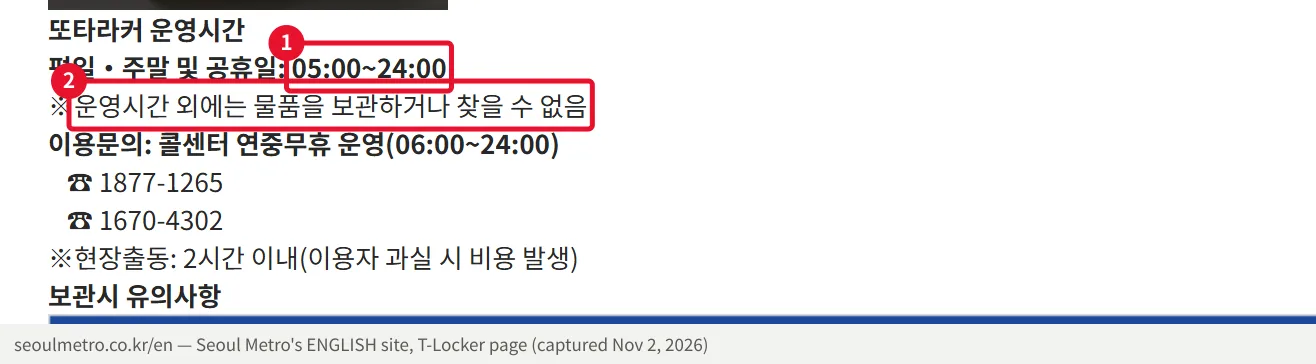
| Opening hours | 05:00–24:00, every day including holidays |
| Outside those hours | You can neither store nor collect |
| Locker sizes (W×D×H) | S 50×30×60 / M 50×45×60 / L 50×90×60 cm |
| Items 50cm or larger | Not allowed |
| Left 5 days or more | Moved to a separate place |
| Compensation if they damage it | Up to KRW 100,000, after verification |
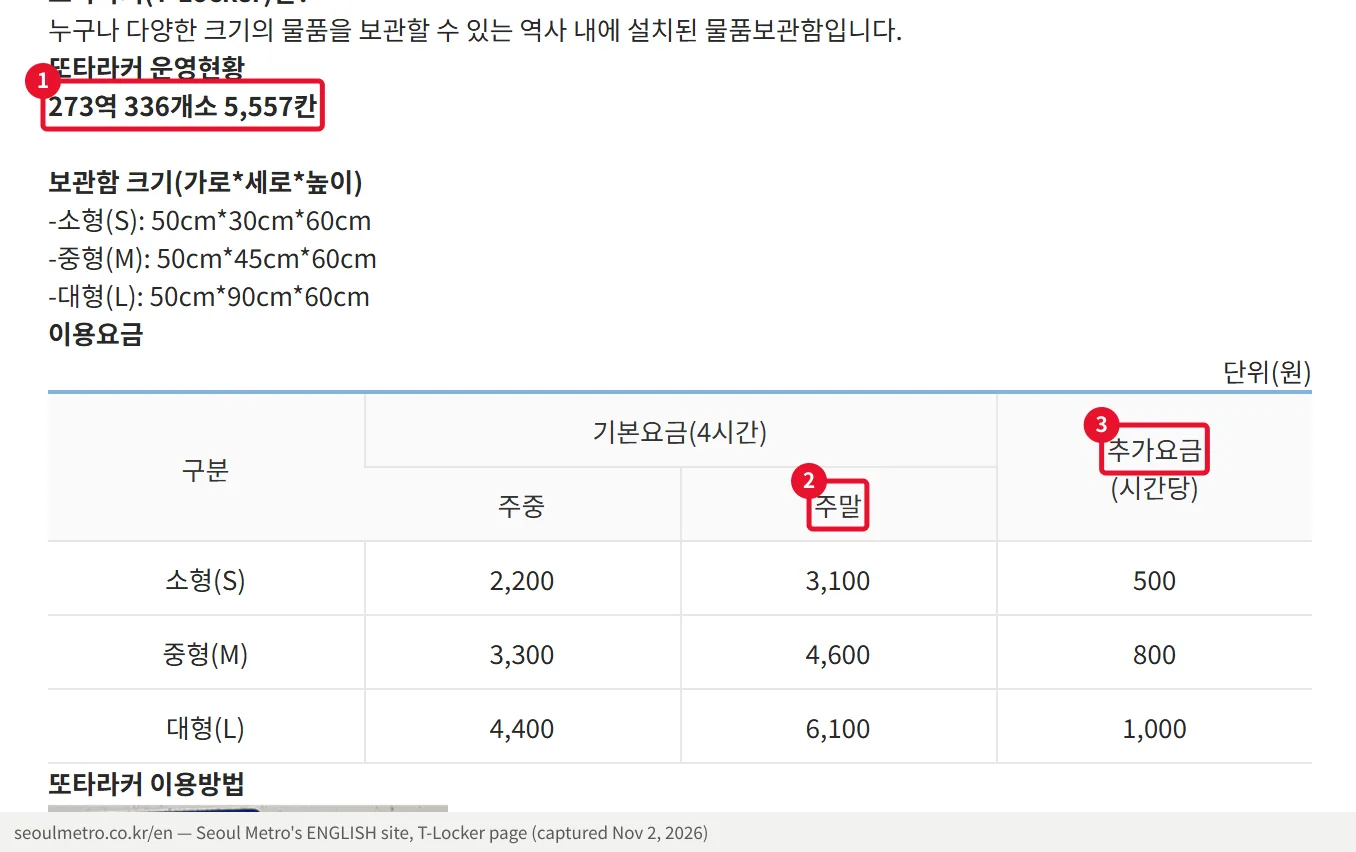
| How many | 273 stations, 336 locations, 5,557 cells |
What a Locker Costs, and Why the Weekend Is a Different Price
 Source: seoulmetro.co.kr/en, T-Locker page (captured Nov 2, 2026)
The fee table has four columns and no English. Read left to right:
| On the screen | How it reads | What it means | The values in that column |
|---|---|---|---|
| 구분 | gubun | Which size | 소형 (S) / 중형 (M) / 대형 (L) |
| 기본요금(4시간) | gibon-yogeum, 4 sigan | Base fee, covering 4 hours | — |
| 주중 | jujung | Weekday | 2,200 / 3,300 / 4,400 |
| 주말 | jumal | Weekend | 3,100 / 4,600 / 6,100 |
| 추가요금(시간당) | chuga-yogeum, sigan-dang | Extra fee, charged per hour after the first 4 | 500 / 800 / 1,000 |
| 단위(원) | danwi: won | The figures are Korean won | — |
Two things follow that the price alone does not show.
The base fee buys four hours, not a day. Four hours covers a museum and lunch. It does not cover a day of sightseeing, and the meter then runs hourly.
The weekend costs about 40% more. A small locker is 2,200 on a Tuesday and 3,100 on a Saturday — and the heading says 주말, weekend, with no further definition on the page of which days or hours count.
Run the published arithmetic for a full day in a small locker on a weekday and you get 2,200 for the first four hours plus twenty hours at 500, which is KRW 12,200. For a medium locker, 19,300; for a large one, 24,400. Treat those as arithmetic rather than quoted prices: the page states no daily cap, and it does not say whether the clock keeps running through the overnight closure. If an overnight matters to your plans, that is a question for the call centre before you shut the door, not after.
The Hours Are the Real Constraint
 Source: seoulmetro.co.kr/en, T-Locker page (captured Nov 2, 2026)
평일·주말 및 공휴일: 05:00~24:00 — weekdays, weekends and public holidays, five in the morning until midnight. Then the line marked with a ※, which is the sentence that catches people out:
운영시간 외에는 물품을 보관하거나 찾을 수 없음 Outside operating hours, items cannot be stored or collected.
Not "the station is shut" — the locker itself will not open. If your flight leaves at 06:00 and you planned to pick up a bag at 03:00 on the way to the airport, that does not work. Neither does a midnight bus. The last trains on most Seoul lines run close to that midnight boundary, so the locker closing and your last train are not far apart.
One more line sits under the phone numbers: 현장출동: 2시간 이내 (이용자 과실 시 비용 발생) — if someone has to come out to the locker, they will be there within two hours, and you pay if the problem was yours.
What You May Not Put Inside
 Source: seoulmetro.co.kr/en, T-Locker page (captured Nov 2, 2026)
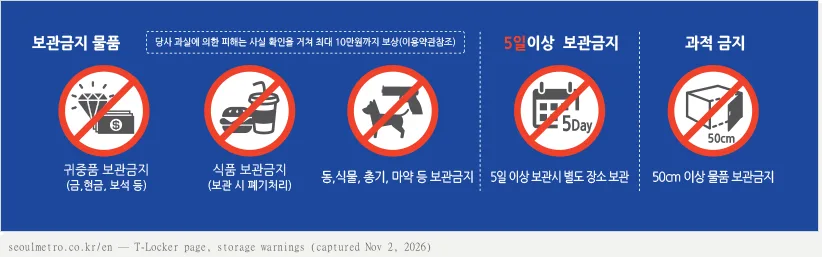
The blue banner on the same page is an infographic, and it carries four rules that are not written anywhere else on the site.
No valuables — 귀중품 보관금지 (금, 현금, 보석 등): gold, cash, jewellery. The small print in the dashed box explains why that matters: 당사 과실에 의한 피해는 사실 확인을 거쳐 최대 10만원까지 보상 — damage caused by the operator's own fault is compensated up to KRW 100,000, after the facts are checked, under the terms of use. That is roughly a quarter of what a used laptop is worth. The locker is for a coat and a shopping bag, not for a camera body.
No food — 식품 보관금지 (보관 시 폐기처리). Stored food is disposed of, not returned. A box of pastries bought that morning is not safe in there.
No animals, plants, firearms or drugs — 동·식물, 총기, 마약 등 보관금지.
Nothing 50cm or larger — 50cm 이상 물품 보관금지, under the heading 과적 금지, "no overloading". Read literally that would rule out most cabin suitcases, which stand around 55cm, and it is hard to square with a large locker that is 90cm deep. The page does not say which dimension it means, and we are not going to guess at a rule that decides whether your case fits. If you are travelling with a suitcase rather than a bag, ask the call centre first, or send it instead — T-Luggage is Seoul Metro's own service for moving a case to the airport.
Leaving a Bag for Several Days Is Not What This Is For
Two separate rules make that clear, and both are easy to miss.
5일 이상 보관시 별도 장소 보관 — store something for five days or more and it is moved to a separate place. The page does not say where, or how you get it back.
경과품은 최장 1개월 보관하되 별도의 연기신청 등의 의사표시가 없을 경우 임의로 기증 및 폐기됩니다 — overdue items are kept for at most one month, and without a request to extend, they are donated or disposed of at the operator's discretion.
Between the hourly meter, the five-day move and the one-month disposal, a subway locker is built for hours, not for a side trip to Busan.
Which Stations Actually Have Them
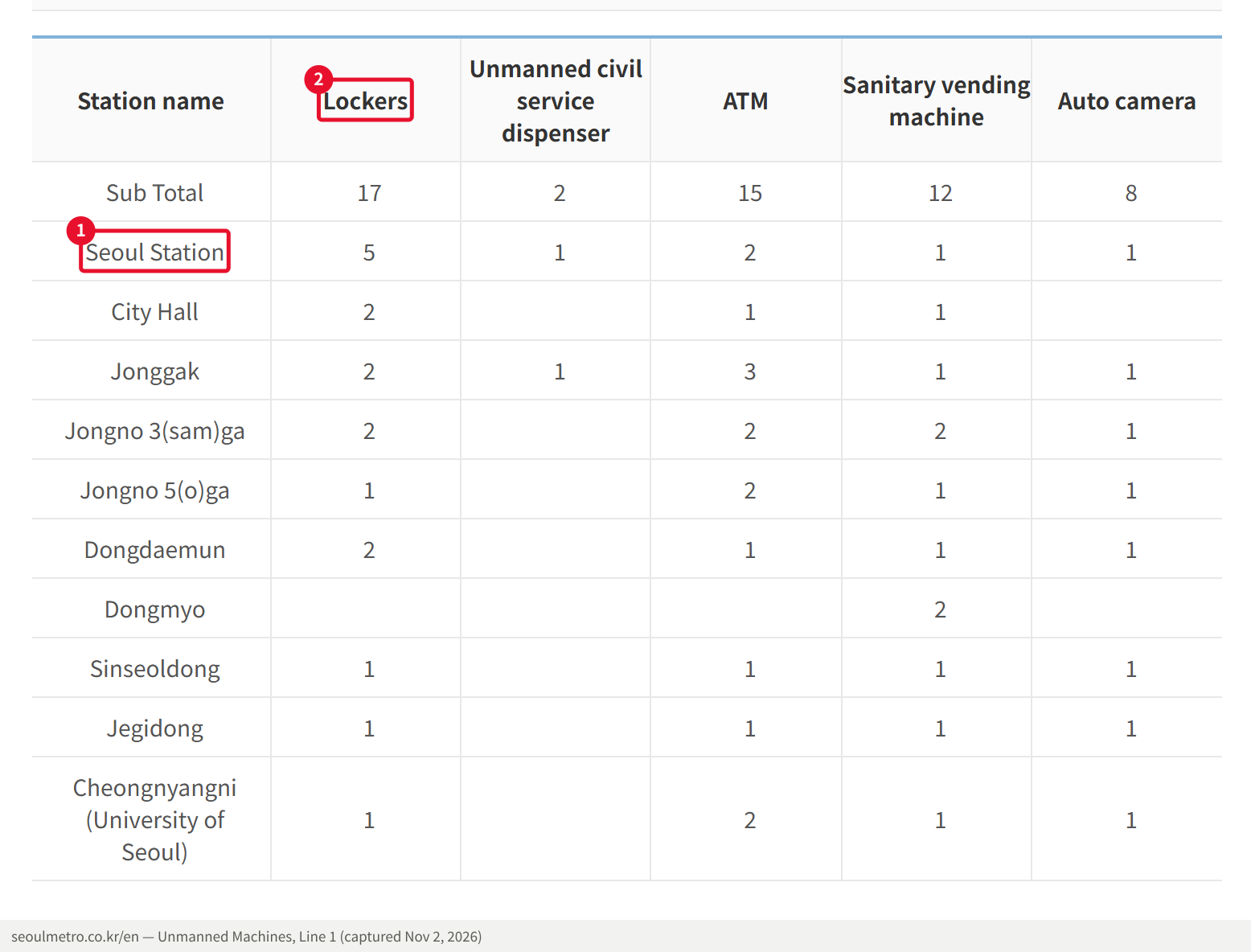
Seoul Metro publishes station-by-station counts in a second place, and this one is in English: the Unmanned Machines page, under User Guide. It lists a Lockers column for every station on lines 1 to 8.
 Source: seoulmetro.co.kr/en, Unmanned Machines, Line 1 (captured Nov 2, 2026)
The table is split by line, which produces one trap worth knowing: a station served by two lines appears twice, with different numbers. Seoul Station shows 5 under Line 1 and 1 under Line 4. Neither figure is the station's total, and the page never adds them up.
Counts at the stations most visitors pass through, read off the same tables:
| Station | Line | Lockers listed |
|---|---|---|
| Seoul Station | 1 | 5 |
| Seoul Station | 4 | 1 |
| Jamsil | 2 | 5 |
| Myeongdong | 4 | 4 |
| Hongik Univ. | 2 | 4 |
| Express Bus Terminal | 3 | 4 |
| Sinchon | 2 | 3 |
| Konkuk Univ. | 2 and 7 | 3 each |
| Gangnam | 2 | 2 |
| Gyeongbokgung | 3 | 2 |
| Anguk | 3 | 2 |
| Itaewon | 6 | 2 |
| Hoehyeon (Namdaemun Market) | 4 | 2 |
| Dongdaemun History & Culture Park | 2 / 4 / 5 | 2 / 1 / 1 |
| Gimpo Int'l Airport | 5 | 1 |
Most other stations on the network show 1, and some — Dongmyo on Line 1, for instance — show none at all.
What These Pages Do Not Answer
They do not say where in a station a locker bank stands. A figure of 5 at Seoul Station tells you they exist; it does not tell you whether they are inside the gates or out, which is the question you will have standing in the concourse with a bag.
The two sources do not reconcile. The T-Locker page gives 336 locations across 273 stations; the per-station tables for lines 1 to 8 add up to 311. Nothing on either page explains the gap, and the per-station column is labelled "Lockers" without saying whether a unit is a cabinet, a bank of cabinets or a single door. The system-wide figure of 5,557 칸 — cells — is the only count of individual doors given anywhere.
They do not cover Seoul Station's mainline or airport-line concourses. Seoul Metro's figures are Seoul Metro's own installations; KORAIL's English site has no locker page at all, so whatever exists on the mainline side is undocumented in English.
They do not say how payment works beyond the app. The photograph on the page shows the new lock as an OTP Door-Lock keypad and the caption says to check availability by station in the T-Locker app, then pay, store and collect — which implies a one-time PIN rather than a coin. It does not say whether a foreign card works in the app, and it labels that lock 신형, "new type", which implies older units behave differently.
Finally, these are published prices on a page with no revision date. If a locker is load-bearing for your day, confirm it on 1877-1265 before you rely on it.


